

Crown Royal: Crafted for a King, Abandoned by a Corporation, and the Trade War That Gave Them Cover
- Shannon Peel
- 2 days ago
- 18 min read
Published: September 3, 2025 | Updated: May 2026 | Shannon Peel, MarketAPeel
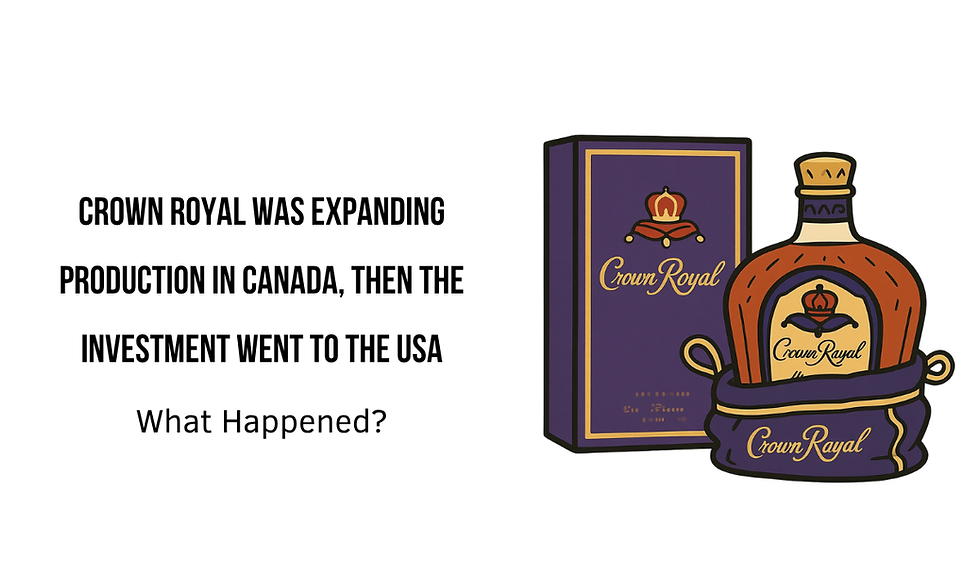
On September 2, 2025, Doug Ford stood at a podium in Kitchener, Ontario, picked up a full bottle of Crown Royal Canadian whisky, and poured it on the ground.
"This is what I think about Crown Royal," he said.
The video went viral. Canadians cheered. Diageo executives presumably reached for something stronger.
But here is what the bottle-pouring did not tell you.
The decision to close the Amherstburg plant and abandon the St. Clair distillery expansion was made internally between late 2022 and early 2024, before the trade war, before Trump's tariffs, before any of the political theatre that followed. The trade war did not cause Diageo to leave Canada. It gave them somewhere to hide while they did it.
That is the real Crown Royal story. And it starts in 1889.
The Story of Samuel Bronfman
On a ship crossing the Atlantic in 1889, a Jewish woman named Mindel Bronfman gave birth to a son. She and her husband Yechiel were fleeing czarist Russia, specifically the anti-Semitic pogroms sweeping through Bessarabia, the region of the Russian Empire that is now Moldova. They were not poor. Yechiel had been a successful tobacco farmer. But no amount of wealth protected Jewish families from the state-sanctioned violence that was driving hundreds of thousands of them out of Eastern Europe in the late nineteenth century.
The baby boy born on that ship was named Samuel. He would become one of the most influential Canadian of the twentieth century, the founder of the world's largest distillery company, and the man who created Crown Royal.
The Bronfman family arrived in Canada and settled first near Wapella, Saskatchewan. They brought their rabbi and two servants. But the tobacco farming that had made Yechiel prosperous in Bessarabia was incompatible with the Canadian prairie climate. He found work on the Canadian Northern Railway, then in a sawmill, then in a wood-fuel delivery business with his sons. By 1903 the family had saved enough to buy a hotel in Manitoba.
Young Sam noticed something at the hotel. The bar was where the money was. Not the rooms. Not the food. The liquor.
Sam owned the Bell Hotel in Winnipeg. When Manitoba went into prohibition in 1916, Sam did not close. Betcha didn't know Manitoba was dry from 1916-1923.
That didn't stop Sam, he found the loopholes. He and his brothers set up storage warehouses on provincial borders, what they called "boozeariums," to distribute legally distilled whisky across provincial lines. When American Prohibition arrived in 1919, Sam bought 300,000 gallons of alcohol in the United States and converted it into 800,000 gallons of whisky in Canada, selling it at a 500% markup to American bootleggers.
His customers included the Chicago operation of Al Capone.
In 1922, his brother-in-law was murdered, allegedly by bootleggers competing for the same territory. The family name made the newspapers in ways Sam did not appreciate. It was time to get legitimate.
He moved to Montreal for a new start to rebuild his reputation. In 1924 he founded Distillers Corporation. In 1928 he acquired Joseph E. Seagram and Sons of Waterloo, Ontario, one of Canada's oldest and most prestigious distilleries, and built Distillers Corporation-Seagram's Limited. The company that had made its initial fortune supplying Prohibition-era America with bootleg whisky was now one of the most respected legal distillers in the world.
Sam Bronfman spent the rest of his life chasing the respectability that the Prohibition years had complicated. The obsession expressed itself in quality. He studied Scotch whisky. He brought Scottish blending expertise to Canada. He developed an almost pathological focus on consistency, "When a man goes into a store for a bottle of Coca-Cola, he expects it to be the same today as it will be tomorrow," he said. "The great products don't change."
By the mid-twentieth century, Seagram's was the largest distillery company in the world. Seagram's VO and Seagram's Seven Crown were among the best-selling whiskies on earth. Chivas Regal, Mumm Champagne, Martell Cognac, the portfolio stretched across every category of premium spirits. Sam Bronfman had taken a family of Jewish refugees who arrived in Saskatchewan with a rabbi and two servants and no prospect of repeating their old success, and built one of the greatest commercial dynasties in Canadian history.
He was president of the Canadian Jewish Congress from 1939 to 1962 and helped found institutions that still stand. The Bronfman Building at McGill. The archaeology wing of the Israel Museum in Jerusalem, bearing the names of Samuel and Saidye Bronfman. He had arrived in Canada as a refugee from state persecution and left it as one of the most consequential Canadians of his era.
His wife Saidye, also from a Jewish family that had fled Russia, came from Plum Coulee, Manitoba. They married in 1922 and had four children: Aileen, Phyllis, Edgar, and Charles. Together they built not just a business empire but a philanthropic legacy that outlasted the company itself.
Sam Bronfman died in 1971, still running Seagram's.
Thankfully, he never knew what his grandson would do to it.
The Whisky Made for a King
In 1939, the year Samuel Bronfman became president of the Canadian Jewish Congress, the same year Hitler invaded Poland and the same year Canadian soldiers began shipping out to fight the war that would kill millions of European Jews, the family his parents had left behind, King George VI and Queen Elizabeth came to Canada.
They were the first reigning British monarchs to visit. It was an enormous occasion. The royal tour crossed the country by train from Halifax to Victoria, drawing enormous crowds at every stop.
Samuel Bronfman wanted to mark the moment. A Jewish refugee's son, now the most powerful man in the Canadian spirits industry, wanted to present something worthy to the Canadian monarch. He assembled his best blenders. They tried over 600 combinations before settling on one. The result came in a cut glass decanter, shaped like a coronation crown, wrapped in a purple velvet bag with gold stitching, the colours of royalty.
He named it Crown Royal.
The symbolism was not subtle and it was not accidental. A man whose family had been driven from czarist Russia because they were Jewish was creating a tribute to the British Crown, the same Crown under which Canada was providing a refuge his parents could not have imagined in Soroki, Bessarabia. The whisky was not just a product.
Crown Royal Ended Up British
To understand why Crown Royal is owned by a British corporation today, you need to understand what happened to Seagram's because it is one of the great cautionary tales in Canadian business history, and it has nothing to do with the quality of the whisky.
Samuel Bronfman, "Mr. Sam" ran Seagram's with an iron hand from its founding through to his death in 1971. He'd built it into the largest distillery company in the world, an impressive feat for a Canadian company. Crown Royal, Chivas Regal, Mumm Champagne, Martell Cognac.
His son Edgar Bronfman Sr. inherited the empire and ran it competently for over two decades, adding a significant stake in DuPont, the American chemical giant, that became the most stable and profitable asset in the entire Seagram's portfolio. By the mid-1990s, that DuPont stake represented approximately 70% of Seagram's total earnings.
In 1986, Edgar Sr. made the decision that set everything in motion. Without consulting his brother Charles, who was co-chairman of the company, Edgar Sr. appointed his son Edgar Bronfman Jr. as his successor. Charles sensed the problem but did not push back. "Nobody wins in a family war. Nobody," he later told CBC.
Edgar Jr. had spent years in Hollywood as a film and music producer before returning to the family business. He was smart, charming, and completely convinced that the future was in entertainment, not liquor.
In 1995, he sold Seagram's entire stake in DuPont, all of it, $9 billion, to fund his entertainment ambitions. He bought MCA, Universal Pictures, and PolyGram, the music company. Seagram's went from owning one of America's great industrial companies to owning a film studio and a record label. The stable DuPont dividends that had funded everything were gone. The entertainment investments underperformed.
The final act that bankrupted Seagrams.
In 2000, at the height of the dot-com bubble, Edgar Jr. negotiated the sale of Seagram's to French conglomerate Vivendi SA. The deal was valued at $32 billion. The Bronfman family would be paid in Vivendi shares.
Everyone who understood corporate finance warned them not to accept shares. Vivendi's CEO Jean-Marie Messier was on a debt-fuelled acquisition spree, buying media companies, utilities, and entertainment assets across Europe and North America at prices that made no sense. Edgar Sr. later described him: "He just kept buying everything in sight, like a kid in a candy store. And he didn't care what the price was."
Within two years, Vivendi's share price collapsed under the weight of its debt. The $32 billion in Vivendi shares the Bronfmans received became worth a fraction of that value. Vivendi, drowning in debt, was forced to sell Seagram's spirits and wine assets in a distressed sale.
In 2001, Diageo, the British multinational, acquired Crown Royal and Seagram's other spirits brands. Pernod Ricard acquired Chivas Regal and the remaining assets.
The empire Samuel Bronfman built over three generations, the Canadian whisky that was crafted for a king, the purple velvet bags that every Canadian child remembers, was dissolved in a bankruptcy fire sale by a French media conglomerate that had bought it at the peak of the biggest speculative bubble in history.
Charles Bronfman, reflecting on the demise years later, called it simply: "A disaster."
Crown Royal did not become British because Canada failed to protect it. It became British because the grandson of the man who created it decided whisky was too boring and Hollywood was the future.
Edgar Jr. was wrong about Hollywood. He was wrong about Vivendi. He was wrong about accepting shares instead of cash. And the cost of those mistakes was paid not by him, he moved on to run Warner Music, but by the Canadian workers, Canadian farmers, and Canadian communities who had built their livelihoods around a brand that was now owned by people who had never heard of Gimli, Manitoba.
Crown Royal Became Another Line Item
Diageo owns Johnnie Walker, Smirnoff, Guinness, Don Julio, Captain Morgan, Baileys, and 200+ other brands sold in 180 countries.
Diageo continued operating the Gimli distillery in Manitoba, where 1.7 million barrels of Crown Royal age in 56 warehouses. They ran the Amherstburg, Ontario plant for US-market bottling. They operated a facility in Valleyfield, Quebec for Canadian and international markets.
Between 2018 and 2024, Diageo invested approximately $150 million in Canadian facilities. The operation was functioning. The brand was performing. Crown Royal remained the number one Canadian whisky in the United States, the 4th best selling spirits in America.
Why Distilleries and Bottling Plants Are Never in the Same Place
When Samuel Bronfman created Crown Royal in 1939, it was distilled at Seagram's Waterloo distillery in Ontario. Crown Royal was an Ontario product from birth. The Gimli distillery did not exist until 1968, nearly thirty years after the whisky was created, when Seagram's needed to expand production capacity. They chose a site on the southwestern shore of Lake Winnipeg in a small Icelandic-settler community called Gimli, which means "safe haven from hellfire" in Old Norse.
The distillery moved to Manitoba in 1968 to be closer to the farms and water used to make it. The bottling stayed in Ontario. And that separation is not a quirk of Crown Royal. It is how the industry works.
A distillery needs to be where the ingredients are, specific water, specific grain, vast warehouse space for aging. Remote is fine. Gimli fills 1,000 oak casks every single day. The mature liquid travels by dedicated Crown Royal tanker rail cars to blending and bottling plants, Amherstburg On and Valleyfield, PQ.
A bottling plant needs to be where the customers are, major highways, rail connections, large labour pools, proximity to distribution networks. Amherstburg sits 25 kilometres from the Windsor-Detroit crossing, one of the busiest commercial border crossings in North America. For 7.2 million cases heading to American distributors annually, that location made straightforward logistical sense.
The Plan That Was Going to Change Everything
In March 2022, Diageo stood in St. Clair Township, Ontario and made a promise.
A $245 million distillery. Four hundred acres on Moore Line near Highway 40 in Lambton County, the heart of southwestern Ontario's grain belt. Carbon neutral from day one, running on 100% renewable energy. Diageo's first original carbon-neutral distillery anywhere in the world. Capacity to produce 20 million litres of absolute alcohol annually.
Crown Royal only. Exclusively. This was not a generic Diageo facility. It was Crown Royal's second home in Canada, purpose-built for one brand, dedicated to one brand.
The scale of the ambition tells you what Diageo believed about Crown Royal in 2022. Gimli produces 33 million litres annually. St. Clair was going to add 20 million more, increasing Crown Royal's Canadian distillation capacity by 61%. Not quite doubling.
Why Ontario rather than expanding Gimli? The grain supply, St. Clair sits in the heart of southwestern Ontario's agricultural belt, surrounded by the corn, rye, and barley farms that would have supplied the distillery at a fraction of the cost of shipping grain to remote Gimli. The proximity to Amherstburg, 100 kilometres away, would have created an integrated Ontario production corridor. The renewable energy grid. And the practical reality that building a major industrial facility in southwestern Ontario is easier than doubling the size of an operation in a town of 2,300 people on the shores of Lake Winnipeg.
"We are excited about Diageo's plans to invest in St. Clair Township," said then-Mayor Steve Arnold at the announcement. "This significant investment will be a tremendous fit with the ongoing diversification of the local economy."
Spirits Canada CEO Jan Westcott called it "a very sizeable plant" that would "significantly boost purchases of Ontario-grown grain."
The Crown Royal plant at Gimli and the Black Velvet distillery at Lethbridge, built in the late 1960s and early 1970s, represented the last time major investments were made by the spirits sector in Canada. St. Clair was going to be the first new Canadian distillery in fifty years.
The Decision That Was Made While Nobody Was Watching
Four months after the St. Clair announcement, July 2022, Diageo filed a Supply Chain Agility Programme with the SEC. Five years, fiscal 2023 to fiscal 2027. Total implementation cost up to £500 million. Goal: rationalize the global supply chain, improve resilience and agility, drive efficiencies. Majority of savings expected to be delivered in fiscal 2025 and beyond. The programme commenced immediately.
The language in Diageo's fiscal 2023 annual report is specific: exceptional charges were taken "primarily relating to accelerated depreciation of assets and impairment of property, plant, and equipment directly attributable to the programme in North America."
By fiscal year 2023, the year ending June 2023, Diageo's auditors were already writing down North American assets under this programme. Canadian facilities were almost certainly in scope.
Large corporations do not announce facility closures at the same time they decide them. The planning, the financial modelling, the labour relations preparation, the legal review, all of it happens 12 to 18 months before any public announcement. For a closure involving 168 unionized workers and a provincial government with $765 million in annual purchasing power, the preparation is even more careful and the timeline even longer.
The internal timeline that the research makes clear:
Late 2022 to mid-2023: The supply chain review is identifying specific facilities for rationalization. Amherstburg — aging, high-cost, in Ontario rather than near US distribution centres, bottling primarily for the US market — is almost certainly identified as a rationalization target. St. Clair — unbuilt, expensive, in a Crown Royal market that is beginning to soften — starts to look like a commitment that does not survive the new financial reality. Alabama — southern US distribution corridor, CSX Select rail site, state business incentives — is identified as the strategic alternative.
Late 2023 to early 2024: Internal decisions are made. Pause St. Clair. Close Amherstburg. Build Alabama. Nobody in Canada is told. Diageo continues meeting with St. Clair Township officials and telling them the project is coming.
November 20, 2024: The St. Clair pause is announced publicly. Mayor Jeff Agar says it came "out of the blue." He is told it was nothing the township did, nothing the government did. He stops buying Crown Royal. "I used to have Crown Royal and I haven't bought a bottle of Crown Royal since this happened neither," he tells CBC Radio.
January 30, 2025: The Alabama plant is announced. $415 million. 360,000 square feet. Multi-million case annual capacity. The trade war has not started. Trump's broad tariffs are still weeks away.
August 28, 2025: The Amherstburg closure is announced. The trade war is now in full swing. The timing provides perfect political cover for a decision that was made approximately two years earlier.
Diageo did not abandon Canada because of the trade war. They abandoned Canada and the trade war gave them somewhere to hide.
Why Diageo Really Closed Amherstburg
The supply chain programme explains the strategic decision. The market context explains the urgency.
Canadian whisky expert Davin de Kergommeaux , author of Canadian Whisky: The Portable Expert and 25 years of industry research — said it clearly to CBC the day after the announcement: "People are drinking less alcohol, brown spirits. In fact, distilled spirits in general are not selling as well as they used to. Nobody's meeting their targets. This has nothing to do with tariffs. This is something that's been in the works for three years."
The global spirits market collapsed after the pandemic boom. US beverage alcohol volumes contracted 5% in 2025. Spirits fell 4%. Canadian whisky sales in the US fell 5.1% in value. In Canada, Statistics Canada confirmed spirits sales by volume fell 4.4% in 2024-25, the fourth consecutive year of decline.
Diageo's own financials confirm the pressure. Operating profit fell 27.8% in fiscal year 2025. Net debt hit $21.9 billion. North America saw organic net sales decline 2.7%. The stock price fell over 20% from its peak.
In May 2025, Diageo launched the Accelerate programme, a separate, newer cost-cutting initiative targeting $500 million in savings over three years, later increased to $625 million. This was a crisis response to accelerating financial deterioration, layered on top of the Supply Chain Agility Programme that had been running since 2022. Two programmes. Both cutting. Both pointing at Canada.
The Amherstburg closure announcement in August 2025 coincided with the Accelerate programme's North American rollout. The decision to close was almost certainly made under the Supply Chain Agility Programme 12-18 months earlier. Accelerate provided the financial and communications framework for announcing it.
The Quebec Story Nobody Told
Here is the detail that the Ontario political coverage buried entirely.
The Amherstburg announcement did not say all the bottling was going to the United States. US-market bottling moved to US facilities. Canadian-market and international-market bottling moved to Diageo's Valleyfield, Quebec facility.
Jobs almost certainly were created or preserved in Quebec as a result of the Amherstburg closure. Diageo refused to confirm how many. Unifor specifically demanded Diageo "come clean" about job movements to both the US and Quebec. Diageo refused.
Quebec's government urged Ford to back down from his LCBO threat. They had every political reason to stay quiet. They were receiving production, not losing it.
The "Canada versus the United States" framing was politically effective and analytically incomplete. The full picture is a three-way split: some production stayed in Canada but moved provinces, some moved to the United States, and 168 Amherstburg workers lost their jobs regardless.
The Ford Confrontation, Theatre With Real Stakes
What followed the August 28 announcement became one of the most publicly dramatic corporate-government standoffs in recent Canadian history.
September 2, 2025: Ford pours Crown Royal at a Kitchener press conference. "Dumb as a bag of hammers." Goes viral across Canada.
October 4, 2025: Ford escalates at a Unifor rally in Brampton, threatening to pull Crown Royal and Smirnoff from LCBO shelves. The LCBO spends $765 million annually on Diageo products across all brands.
November through December 2025: Behind the scenes, multiple rounds of offers from Diageo as the plant closure deadline created, according to Global News sources, "more willingness to bring more to the table."
January 2026: Ford confirms Crown Royal will be pulled from LCBO but backs down on pulling other Diageo brands.
February 13, 2026: The deal. Diageo commits to $23 million in Ontario investments. Crown Royal stays on LCBO shelves.
February 25, 2026: The Amherstburg plant closes two days early. 168 workers lose their jobs.
The $23 Million Deal, Who Actually Won
The breakdown of what Diageo committed: $11 million purchasing grain neutral spirits from eastern Ontario suppliers. $5 million in Ontario-based marketing spend. $3 million for RTD beverages through a Toronto co-packer. $2 million for packaging from an east Toronto manufacturer. $1 million for agricultural organizations. $500,000 for Amherstburg economic development.
The LCBO spends $765 million annually on Diageo products. Diageo spent $23 million, 3% of their annual LCBO revenue, to protect 100% of their most important single retail relationship in North America.
Most of that $23 million was money Diageo was going to spend in Ontario anyway. The $11 million in grain neutral spirits, they were already buying Canadian inputs. The $5 million in Ontario marketing, they sell $765 million of product through LCBO annually. Formalizing existing spend as new investment is a standard corporate communications technique.
NDP MPP Lisa Gretzky put it plainly: "The plant will still be closed. Not a penny of the $23 million will go towards helping these workers feed their families, and only four per cent of it is going to our community."
Ford declared victory. Diageo got what they wanted. The plant closed. 168 workers got enhanced severance. The Amherstburg community got $500,000.
After signing the deal, Ford told The Guardian: "It's all a bunch of BS. It's all going to Alabama. Mark my words, it's going to Alabama."
What Alabama Does and What St. Clair Was Going to Do
The Alabama plant opened April 22, 2026. $415 million. 360,000 square feet. It handles Crown Royal, Smirnoff, Don Julio, Johnnie Walker, Captain Morgan, and other Diageo brands for the US market.
Here is the distinction the political coverage almost entirely missed.
The Alabama plant cannot produce Crown Royal whisky. It is legally impossible. Alabama bottles Crown Royal, filling bottles with liquid that arrives from Gimli by tanker rail car. Alabama replaced what Amherstburg was doing. Closer to US customers, lower freight costs. That is the supply chain logic.
St. Clair was going to do something entirely different. St. Clair was going to make the liquid, 20 million litres of new Crown Royal annually, distilled from Ontario grain, aged in Canadian oak barrels, adding 61% to Crown Royal's Canadian production capacity. That production was simply cancelled. It does not exist in Alabama. It does not exist anywhere.
The growth in Canadian whisky production that Diageo promised in 2022 was never built. The bottling that was Canadian is now American. The liquid stays Canadian because it legally has to. Everything else moved south.
The Empty Field on Moore Line
Today, where Diageo promised Crown Royal's second Canadian home, there is a field of phragmites, the invasive wetland grass that colonizes disturbed land, on 400 acres near Highway 40 in St. Clair Township.
Diageo still owns the land. A company representative confirmed they plan to retain the property for future development of a Crown Royal distillery and warehouses. The zoning is in place. The severance application is complete.
Mayor Jeff Agar, who welcomed Diageo in 2022 and spent two years reassuring his community the project was coming, told CBC Radio what he did after the pause was announced.
"I used to have Crown Royal and I haven't bought a bottle of Crown Royal since this happened neither."
The man whose community was promised Crown Royal's Ontario home stopped drinking it when the promise was cancelled.
Whether that field on Moore Line ever becomes a distillery depends on whether Crown Royal's sales recover enough that Diageo needs the capacity — and whether, when that moment comes, they decide to build it in Ontario or somewhere else.
The Alabama plant is open. The St. Clair field is waiting.
A Canadian Whiskey, for How Long?
To carry the name Canadian whisky, Crown Royal must be mashed, distilled, aged, and blended in Canada for a minimum of three years. The moment Diageo moves distillation out of Gimli, Crown Royal legally ceases to be Canadian whisky. The purple bag, the crown-shaped bottle, the 86-year story, all of it depends on the liquid being Canadian.
Or does it?
How many Canadians know the origin story of Crown Royal?
How many Canadians know it is originally a Canadian brand?
How many Canadians see it in US culture more than Canadian culture?
Crown Royal is the fourth largest selling spirit in the United States and 70% of those who are drinking it, don't know it's a Canadian Iconic brand.
Crown Royal is a massive American bar brand. The purple bag appears in American hip hop culture, American country music, American sports bars. Drake references it. NFL players are photographed with it. The brand's cultural gravity in North America has shifted so far south that younger Canadians consuming American media, likely associate it with American brands, not Canadian.
Will it matter if it remains a Canadian Whiskey? Because that seems to be the only reason to keep distilling it in Gimli, Manitoba. What if the nation of the Whiskey no longer matters and moving it south makes more sense financially?
The Bigger Story, Colony or Nation
Crown Royal was created as a tribute to Canada's monarch by a Canadian entrepreneur who believed Canadian whisky could be as good as anything in the world. Then it was sold to a British conglomerate who managed it efficiently, grew it profitably, and between 2022 and 2024 quietly decided to shift its North American manufacturing centre of gravity to the United States.
Not because of the trade war.
Two years before the trade war.
The trade war was the cover story. The Supply Chain Agility Programme was the real story. The internal reviews of 2022-2023 were the real story. The St. Clair announcement made while the review that would kill it was being written, that is the real story.
This pattern is not unique to Crown Royal. It is how every Canadian brand that has been acquired by a foreign conglomerate eventually travels. A Canadian family builds something extraordinary. A foreign corporation acquires it. Internal reviews optimize it toward the corporation's largest market. Canadian jobs, Canadian content, Canadian investment gradually migrate. What remains in Canada is the legal minimum required to maintain the brand story that gives the product its value.
Bick's Pickles. Crown Royal. The BC forestry companies. The pattern repeats because the policy framework permits it — and because Canadians have spent decades accepting that brand sovereignty is someone else's problem, right up until the moment a politician pours a bottle on the ground and calls it fighting back.
Doug Ford pouring a bottle on the ground made for a great video.
What Canada needs is a policy that means he never has to pour one again.
Shannon Peel is a Brand Narrative Strategist and the founder of MarketAPeel. She builds strategic brand narrative ecosystems that help organizations earn authority, credibility, and citations in the age of AI search. She writes about brand strategy, marketing, GEO, business, and the Canadian economy.
**SEO Metadata:**
- **Title:** Crown Royal: Crafted for a King, Abandoned by a Corporation, and the Trade War That Gave Them Cover
- **Meta description:** The trade war did not cause Diageo to abandon Crown Royal's Canadian manufacturing. The internal decisions were made two years before the first tariff. Here is the full story — from Samuel Bronfman's 600 blends to the empty field in Lambton County.
- **Tags:** Crown Royal Canada, Diageo Amherstburg closure, Doug Ford Crown Royal, Crown Royal St. Clair Township distillery, Canadian brand sovereignty, Diageo Supply Chain Agility Programme, Crown Royal Gimli Manitoba, Crown Royal Alabama plant, LCBO Crown Royal, Canadian brands foreign ownership, Diageo Accelerate programme

Comments